code blog

Liming in Guyana with Ingrid

Posted on February 8th, 2010 in: Uncategorized

By Ingrid Ermanovics,

Feb 6, 2010
I spent the morning “liming” (that’s ‘Guyanese’ for hanging out) but spent the afternoon in the next region to the west across the massive Demerara River.  The General Manager of the Guyana Book Foundation (GBF), Leila Jagdeo, graciously gave up her Sunday afternoon to take me out of Georgetown and into its rural surroundings.

Once again, reminders of the English, Dutch and even French heritage were everywhere – from the architecture of houses and churches to the physical features of dykes. The quaint and colourful  town names, such as D’oratoire, L’Heureuse Aventure, and Bon Voisin also pay hommage to the country’s past.

The idea was to see more of the country but for me it was a useful acquaintance with the context in which GBF operates.  How else can I work together with them without knowing the lay of the land?
Crops of rice and sugar cane abounded as did controlled irrigation canals cut far into the land from the massive Demerara that pours out from the interior for hundreds of kilometres.  We made it as far as the Berbice River, another powerful force flowing toward the ocean – and wandering around the market I realized that there seems to be nothing that does not grow in Guyana (Mrs. Jagdeo would tell you there is no tea … but I think that is only because no one chooses to grow it!).  There are sapodillas, star fruit, star apples, watermelon, pumpkin, papaya, mangos of several types, pineapple (on a stick even), tangerines, avocado, bananas of several types, plantain and more. There  is an abundance of readily available and very fresh local vegetables  including  bunches of callaloo and shallots, piles of eggplant, edo, chilli peppers, ginger, tomatoes, avocadoes, cashews and walnuts .  Don’t ask me where the rice and sugar cane were …

I should mention here the many beautiful crafts and products that are also available in Guyana.  The nine Amerindian tribes produce the blow dart chambers, hair ornaments, combs from different combinations of bone, wood, pine needs, and feathers; massive cassava squeezers (matapi) that help to create edible cassava; pottery, carved melon shells, seed necklaces, tree sap ‘leather’, bowls and jewellery of purple heart wood;  straw products such as baskets, earrings, ducks, boxes of all shapes, coasters and more.  There are also beautiful leather products including sandals and bags.  There is wonderful gold jewellery and paintings of many Guyanese scenes,  The agricultural products are also worth noting – in no particular order - rum, coffee, cocoa, sugar, cashews to name a few.

The day ended with a drive by the teacher training college and the University of Guyana.  Both are still functioning but they face the same challenges as other Guyanese institutions – insufficient human resources, students with lower levels of literacy and the need for more materials and operating funds.   We stopped by a pond on campus with the other-worldly national lily pad and flower covering it (who knew the lily pads are covered in thorns on the back?) and to our surprise we were told to beware the caimans within!

CODE in the Field - Back in Liberia with Kathy Stinson

Posted on February 5th, 2010 in: CODE in the Field, Liberia

By: Kathy Stinson
February 2, 2010
I’m sitting on the fourth floor balcony of the Cape Hotel in Monrovia in shorts and t-shirt listening to a mixture of surf and hotel generators, and the occasional honking of a motorcycle horn. It’s just after nine o’clock at night. African music has been added to the surf/generator mix as I type this.

Who knew that sitting at my dining room table 28 years ago, writing about a girl who likes red best, would lead to this?!
It probably sounds like a holiday, especially to people back home experiencing some of the coldest days of winter so far this year. But I’m working hard here in Liberia, sharing some of what I’ve learned about writing and editing over the years with people keen to write, even though it may not sound much like work. And it is, after all, a pretty fine kind of hard work to be given the chance to do.
This year I’m working with writers who have stories nearing publication and writers who hope the stories they’re working on might be chosen for the next publishing season. Some I worked with last year and they quickly became like friends. There are new faces and new voices in the group, too, and we spent part of our first hour together getting introduced and making sure I could pronounce their names correctly: Ovie, Cherue, Akoi.
More later, but for now I have more stories to read, more work to prepare for tomorrow…

CODE in the Field - Three Days in Guyana

Posted on February 5th, 2010 in: CODE in the Field, Guyana

By: Ingrid Ermanovics -CODE Program Manager

Tuesday Feb 1-4, 2010

I arrived bleary eyed – having enjoyed my flight over the rain forest and massive rivers of the Guyanese hinterland -  in my crumpled black pants, shirt and sweater to a wall of heat and humidity, splashes of flowers and wonderful fragrances — and sunshine!  So many of the houses and buildings here are made of wood and raised on stilts, many of the official ones dating from Dutch or British colonial times.

In the afternoon, I headed to the Guyana Book Foundation to meet staff and see the well-established office.  I was greeted by the five staff and given a tour.  The office is part bookstore - where GBF displays the books it publishes, procures and purchases.  Teachers and  tertiary students were in and out looking around and making purchases for their schools or themselves (only one book per student – with ID – as the prices are largely subsidized and the privilege is intended to be shared around).

GBF has a varied program, one that is largely based on book distribution, but also involves the training of teachers and librarians.  I learned about the daunting task of receiving, storing, tracking and distributing thousands of books each year.

The following day I met nursery workshop facilitators, both highly experienced and trained early childhood specialists, who the General Manager of GBF Leila Jagdeo, and I accompanied on a tour of 7 nursery school in the 40 degree heat and humidity.  As I got dizzier I realized that I was not keeping up with the liquid intake required but it was nothing a few cold tropical juices couldn’t remedy.

The nursery schools were impressive – their physical structures – but more so the organization and dedication displayed within – literally.  The rooms were full of original, creative and colourful teacher-made learning aids and manipulables of all kinds.  There were plants everywhere and children’s work displayed, songs being sung and stories being told and praise and encouragement doled out.  The children are experiencing so many learning opportunities that are just not available in their homes.  School is also the only place for most to hear and experience standard English

The 4-6 year olds there were as darling and sweet as all children that age are – and so obviously happy and enjoying their days.

Mrs Sukhdeo and Mrs Trott were visiting the schools in advance of a workshop they will run in a day or two – in order to assess student ability, the learning environment and the learning materials and methods – to tailor the workshop as much as possible to the teacher participants who will attend from those schools.  All results were shared and discussed at the end of each visit.  We dropped into these schools in relatively well-off villages, in very poor ones, in formerly extremely violent ones and in some where the majority of families are involved in labour, cutting sugar cane, for example.  The cross-section was an eye-opener for me.

As I walked along the sea wall later that day, the wind blasting me, I took a bite of the mango I had bought and my eyes automatically closed as I took in the intense flavour – and I reflected on what personal benefits program monitoring visits can also bring!Mama\'s Dream

Gord Pronk in Liberia- Challenges and Solutions

Posted on February 5th, 2010 in: CODE in the Field, Liberia

We just finished day 2 and we are winding down on the balcony.  Kathy has a lot of writing to review.

I will explain a couple of challenges and start a discussion about the solution. I guess I have already come up with a solution for the first challenge.

Challenge 1:
We went art-supply shopping after the workshop today. Real art supplies are practically nonexistent in Monrovia. There are art kits for the hobbyist, but the tubes of paint are tiny and the kit contains all this stuff we don’t need.  The artists in the workshop are generally having art supplies brought in from the US by family and friends who are traveling.  This is going to be a major challenge. Because each artist is going to paint roughly 15 pieces, and some of the pieces need to be quite large, we need lots of materials. We need large sizes of water color paper for water colors (Chase), and large canvas pads for most of the others who will work in Acrylics. We ideally need the 19 x 24 inch size. This art needs to be created at “half up” (150%) or “quarter u”p (125%). Our double page spreads are  9  x 16 inches, so half-up would be  13 1/2 x 24 inches.

We have come up with a solution. We have found a good quality poster paper in an office supply store. Chase will use it as-is for his water color work and we will prime this paper with house paint for the acrylic artist. We will get pints or quarts or possibly even gallons of house paint tomorrow in a selection of colors for the acrylic artist. I bought 3 sets of artist acrylics today to supplement the house paint with some more intense colors. They are tiny tubes that won’t go far. We will be resourceful and do what is necessary to make this happen. We are so spoiled in North America. I brought 100 sheets of tracing paper with me, but we will use them up tomorrow. One of the artist knew where we could get more. So it seems we are able to find solutions and move forward.

Challenge 2:
Another challenge we have is the scanning. We will need low quality scans of this artwork for communication with Canada and then there is the problem of the final high-quality scan that will be needed to create the final files for the printer. The artists are creating their final drawings at the large half and quarter up sizes. In order for us to comment on, and approve these drawing we will either need to scan them in many pieces that will be reassembled in Toronto, or we will use digital photographs. The digital photos could have distortion if they are done incorrectly. So we will muddle through with one of these solutions, but we will need to solve the problem of the final scans. I am in favor of shipping the artwork to Toronto, so that we can scan it, unless we can find a good quality large scanner in Monrovia or  possibly at the printers that we will be using.

Challenge 3:
The schedule is another problem. I realize there is some urgency about getting these first four books finished, but this may be a problem. I will have a better idea at the end of the week. I can see that at least one of the artists will be streaking ahead and moving quickly through his book. Each artist is producing 15 significant pieces of art. Some of them may need to paint some of them more than once. I just want to give-a heads up to everyone so that we can discuss the trade off between schedule and quality.
We are now working well together and there is some good energy in the room. All the artists are very enthusiastic and hungry for knowledge. Some of them are quite talented. It is a very rewarding experience. The Exit Cards choke me up.

Here are a couple of my Exit Cards from today:

*   I am greatly getting an impact of which I was lacking: that is the instruction given by Mr. Gord, directs me to a whole lot of hidden secrets in illustration. I praise God for Mr. Gord and wish him well in his endeavor
*   I feel so great about today workshop I pray it will continue like this tomorrow.
*   This work is one of my greatest experience in all my years as an illustrator, I am looking forward to learning how to use the computer (Wacom) the latest use. I’m looking forward to establishing a full partnership.
*   I’m very happy to see myself in this workshop because I am gaining enough of knowledge and experience.
*   As for me I feel very good about the workshop. Its makes me to meet some good people.

CODE in the Field - KENYA

Posted on December 2nd, 2009 in: CODE in the Field, Kenya


By: Sean Maddox - CODE Director of Development

November 27th; Dialogue with Teachers, Parents and Students at Schools in Ibeno

Today we headed to the schools to present our project to the teachers, students and community members and to find out more about the environment where the schools were based.  Our itinerary for the day was packed; 5 schools with a full agenda at each.  Each school was located in the Ibeno zone, but a great deal of traveling on rocky roads was required.  No time for meals or breaks, one school, then the next and so on until we had completed our mission for the day.

I have been traveling to schools in Africa for a long time, mostly to schools where CODE’s programs are active.  It is rare that visits are made to schools by a CODE staff member before the project has been running for some time.  The work we were about to do in Ibeno is usually conducted by CODE’s partners based in the countries. This was a real reality check.

The countryside was beautiful; rolling hills, forests, and flowing rivers.  We drove by fields of tea, maize, kale, fruit trees and of course the suicidal goats.  Many people were working to harvest maize and tea and tended to other work on their land or around their houses. We received curious looks as be passed since motor traffic in the area is seldom, and the vehicles that do pass re known to the people.

At our first stop, Kirwa Primary School, we were greeted by the Head Master Charles O. Ondara and his teachers.  They were all waiting for our arrival, which I must admit was delayed by about half an hour.  Charles gave us a tour of the school then we had the opportunity to speak to the students and parents.  They were all very pleased that we would be helping improve the teaching of reading and writing and providing books, including books in their mother tongue, Ekugusii. 

CODE IN THE FIELD - KENYA

Posted on December 2nd, 2009 in: CODE in the Field, Kenya

by Sean Maddox- CODE Director of Development

Kenya Nov 30, 2009

Two Degrees of Separation

Over the past 24 hours I found myself return to a district in South Western Kenya that I had worked in in 2004. Never had I thought that one day I would be returning to the district of Kisii to start another literacy project.  But here I am in this beautiful part of the country, surrounded by lush forests and farm lands.

After our six hour drive from Nairobi to Kisii -  a drive that took us from a busy capital city through the Great Rift Valley and finally climbing about 7000 feet - we reached the Egerton University branch campus on the edge of Kisii town.  This visit was a courtesy call since the University is a member of our new partner in Kenya, the National Book Development Council of Kenya (NBDCK).  We were welcomed by their representative on the council, Dr. Elkana Ong’esa and then by the principal of the University branch, Dr. John Akama.

Our delegation proceeded to explain the nature of our trip and the project we were initiating in Kisii -  a  project that will work to support the mother tongue in primary education, along with Kiswahili and English.  Dr. Akama was very excited as he is from the area and is on the Kisii Council of Elders, a group working to preserve their language and culture.

At a point in the meeting I noticed a carving that indicated that Dr. Akama had graduated from Ohio University, the same university I had attended for my Masters.  Well it isn’t often that alumni from Ohio University meet in Kisii.  This led to a lively conversation that excluded my delegation for a while.  Our connection became closer when we learned that not only did we share the same university, but the same Faculty Advisor for our Masters thesis.  I can’t wait to share this information with Dr. Bob Walter; I know this will have him laughing all day.

The next afternoon we were making another courtesy call to another member of the NBDCK.  Mr. Elkana Ong’esa lives about an hour away in a community called Tabaka.  Tabaka is world famous for its soapstone carvings.  Elkana has moved back to Tabaka to help the Kisii Soapstone Carvers Co-op Society (KISCOOP) recover from their market decline that was experienced after the post-election riots in 2007 that shook the country.  Due to the insecurity in the country at the time many clients of KISCCOP stopped procuring their products, then the global economic breakdown found Tabaca.

We were welcomed with open arms.  I was overwhelmed by Elkana’s affection for everyone he greeted and worked with.  Upon giving me a very warm hug (actually two) he said we have so much in common and it was just right that I had come to Tabaka.  When an informal meeting started – intended for his staff and my delegation to learn more about each other -  Elkana started by explaining our connections.  It turns out that he had been on a teacher trainer exchange to Montreal  several years before.  He spoke of his love for Canada and shared that as a sculptor he had been so interested in the work of the Inuit and the Inuktitut that he traveled to Inukshuk for three weeks.  According to his hosts they claimed he was the first African to ever visit them; we can be sure he was the first Kisii.  So coming from Canada is what connected us?

No.  He proceeded to tell me years before he had contacted CODE to help him provide books for the community library in Tabaka.  Through our partner at the time, CODE arrange for the library to receive 1,000 books that are still being used in the library today.

To celebrate my visit to Tabaka on behalf of CODE and as part of their cultural tradition, they asked if I would plant a tree for the community to remember this day.  Have you ever planted a tree with 20 people watching, people who grew up and in some cases still work the fields with their hands.  Yes, they had a couple good laughs.  Upon leaving I asked one of the Co-Op staff if she would take care of the tree so that the next time someone from CODE has the privilege to visit they can appreciate the tree that connects us all.


CODE in the Field - Ethiopia

Posted on November 30th, 2009 in: CODE in the Field, Ethiopia

By Ingrid Ermanovics - CODE Development Officer - Ethiopia, Guyana and Liberia

CODE books in Ethiopia November 24, 2009 – The Airport at Addis Ababa, Ethiopia. The flight arrived late and I was more than hazy from lack of sleep but I knew I was back in Africa when I saw a long line of young men waiting to get through passport control and they were each within 4 inches of each other.  I was 7 again waiting in line to get into class in Lobatse and then I was 25 again trying to get my Malawian students to spread out just a little please girls!!!  I smiled and took a deep breath, reminding myself wisely that I had a long way to go before getting through the many hurdles ahead I would have to straddle before entering the country.

But - then I got chatting with an American who is in town to design, with Ethiopians, training in various skin diseases.  Suddenly I was breezing through passport control like a hot knife through butter and my bags were right there waiting for me –both of them!  I might have been home free but had yet to clear my bags before leaving the terminal – not by showing the tags that proved they were mine – but by running them through an x-ray scanner.  For a while I thought I might be on candid camera as one bag would slide backwards while I tried to heave the next one on like some kind of Laurel and Hardy meets Sisyphus thing.  Anyhow, I finally made it through relatively unscathed and realized for the thousandth time that my expectations of ‘Africa’ were way off base.

Why is it that the more experience I get, the less I seem to know?  But what a timely reminder from mama Africa as I headed out into the crowd looking for Ato Tesfaye, CODE-Ethiopia’s Executive Director, who spotted me immediately and greeted me so warmly.  Tesfaye graciously got me to the hotel and I settled into what I expected to be a sleep second only to that kind of deep sleep you used to have after university and before kids.  I did I guess – but only for 3 hours.  So, from 1-5 am I kept myself busy with every sleeping trick in the book and finally fell asleep again for 3 more hours. 

I felt low when I woke up with the sun high but then I heard that Somali-Canadian hit blaring through my window by K’naan … “When I get older I will be stronger, they’ll call me freedom just like a waving flag …” and suddenly I felt better. 

The afternoon was spent at the office where I was warmly re-acquainted with Ato Esayas, a CODE-Ethiopia program manager, and had the pleasure to meet a man that many rave about, Ato Ephraim, a devoted worker at CODE-Ethiopia who could have retired many decades ago but continues to contribute there.  We agreed that the long afternoon had been a stimulating beginning to our work and our plans were set.

On the way home, Tesfaye took me through the street of gold and silver where I saw jewellery like I have never seen – some of it similar to lace, other pieces so grand they could perfectly adorn a bull.  Other pieces reminded me of something that Cleopatra might have worn across her chest and still other pieces were wrought by what I can only imagine was powerful religious inspiration.

I’m excited about this chance to meet the staff at CODE-Ethiopia that continues to support all the work CODE does - from the process associated with publishing books and establishing and monitoring the 20 newest reading rooms — to teacher and librarian training and the promotional events they support.

I’m also excited about visiting the reading rooms and speaking with the librarians themselves, committee members from the community that manage the reading rooms, and the people who use them.  I believe this trip will acquaint me with and connect me to the program here in a way that email and reports alone could never do.

I also hope that by the time I leave Ethiopia, I’ll have a clearer picture of how best to capture the impact of all of this work. I’ll also look at ways to continue refining and expanding CODE Ethiopia’s work as they move towards achieving the goals of their strategic plan during this second half of the five-year program.


CODE in the Field - A Day in the Life of a Kenyan First Grade Student

Posted on November 25th, 2009 in: CODE in the Field, Kenya

By Sean Maddox - Director of Development at CODE

KENYA November 23, 2009: Do you remember your first day of grade 1? Perhaps taken to school by an older sibling or parent. Excited to finally be in grade 1, and to meet your teacher. Perhaps even have your best friend in class with you.

Now imagine that on your first day of grade one you found out you had 10 subjects, and in 3 different languages. The national curriculum is based on the Mother Tongue as a subject and medium of instruction up to grade three, English as a subject and Kiswahili as a subject. And we think bilingual education in Canada has challenges.

Now imagine you are the teacher looking at all of these scared, excited girls and boys, who all have parents expecting you to teach their children. Perhaps you are experienced, perhaps you are a new teacher, do you have the mastery of all languages you must use in your instruction. I would imagine your are as scared as many of your pupils.

This is the reality in schools across Kenya every January. Fresh into a new calendar year millions of students arrive to enter this daunting system. Teachers and students alike have few and unsatisfactory resources to meet the challenge of the national curriculum.

While the mother tongue is the medium of instruction, few publishers will produce books or learning materials since there is not sufficient demand backed by resources. As one publisher put it, we are a for profit industry and profit is in text books that are written in English and Kiswahili.

This is truly a daunting situation for the Kenya education system. A system that is grounded in international best practices as illustrated through their policies, curriculum, syllabus and to an extent, their teacher education. However, they admit they struggle to find practical solutions to benefit the child who enters the education system at the start of each year.

It is based on these challenges that CODE is initiating a new project in Kenya with the National Book Development of Kenya. The project will work to support the teaching or reading and writing and the transition to the medium of instruction in English in grade four. As the Kenya national anthem proclaims, “build this our nation together, and the glory of Kenya, the fruit of our labour, fill every heart with thanksgiving.” There is much going on and no lack of thanks here in Kenya for the support of CODE.

A Morning in Capunda, Niassa Province, Mozambique

Posted on September 28th, 2009 in: Mozambique

By Catherine Macnab, CODE Program Manager

After four days in the Mozambican capital of Maputo, discussing technical aspects of the program with Progresso staff, I looked forward to visiting my first rural school in the northern province of Niassa. 
After an hour or so driving along a dirt road, passing small villages, we arrived at Capunda.
As we met with the school director in his office, the recess bell sounded.  In no time, curious children, who saw the truck arriving with visitors, were jostling to peek in the office door.

Capunda Primary school made changes required by the Ministry of Education and Culture (MEC) to divide the school day into only two sessions — lower grades in the morning and higher grades in the afternoon — instead of three sessions. This increased the number of hours of instruction provided to all children.
The problem at Capunda was that there were not enough school rooms to hold more classes simultaneously. The solution was to construct three ‘temporary’ classrooms in a thatched structure nestled under a number of large shady trees. 


After class resumed, we slipped into the back of the Grade One room to observe a math lesson. It was difficult… It was difficult for the children to keep their heads forward with such unusual visitors behind them. It was difficult for me to remain official, indicating for children to look forward and pay attention, when I wanted to make goofy faces and invite them to sit with me. Somehow we managed. Barely.
The classrooms are rudimentary. A straw wall on one side blocks most of the direct sunlight; school benches are made from suspended branches.  Children balance their books on their laps; the teacher has a chalkboard leaning on a straw wall. The straw wall provides a visual divider between classes, but no sound barrier. Teachers compete against classes reciting or singing next door.
From my view at the back, the classroom seemed normal in the given environment. Of course the benches are uncomfortable for the children to sit on for long stretches – I was given one of the few school chairs – and the books would fare better if the children put them on a table, instead of in the sand. But a refreshing breeze passed through the room, and I was delighted by the rustle of the trees overhead. After all, these children do not spend most of their time inside as most Canadians do, and although I haven’t been in a rural Mozambican home, I would expect to find a similar level of comfort.
 
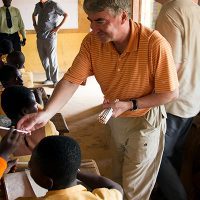
Eventually we regrouped with the director and the teachers to discuss teaching methodologies.  As we finished, I reached into my bag to present some small gifts – sparkly pencils that will probably be used for prizes during reading competitions, and a couple other tools for reading and writing – pencil sharpeners and stencils. The gifts were received with such appreciation and honour.
Then they presented us with a box – it was filled with dozens of bananas from the school plantation. Most of them were green but a few ripe ones were presented to us for immediate consumption. With children and staff watching, I peeled mine, wondering how many of the children came to school without breakfast and needed the banana more than I. But I was an honoured guest — to refuse the gift would have been an insult. I set about the task with determination.
Then I bit into the banana…
I have lived in the tropics, how is it that I had never before eaten a tree-ripened banana!? Words cannot describe the immense pleasure that washed over me from the first taste of that unassuming piece of fruit. I may never again eat a banana that turns from green to speckled on my counter.
Then the school secretary reached behind the door and pulled out a live and loudly complaining chicken. Startled, I was grateful for companions who know how to hold chicken without cellophane.
As I joined my team for dinner that night, I gave quiet thanks for the insight my work provides into lives that are so different than mine. Then I rolled back my sleeves and used my hands to eat the best stewed green bananas and chicken ever prepared.


A Burt in the hand

Posted on August 20th, 2009 in: Uncategorized

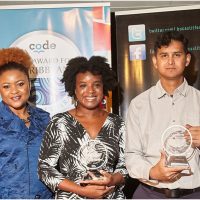
On Monday August 10th, we awarded the first winners of the Burt Award for African Literature during the opening gala of the Reading for All Conference in Dar es Salaam, Tanzania. All three shortlisted authors were present and the energy was high as story synopsis were read and the prizes were announced. Here are a few photos from the evening:

 From l to right:  Pilli Dumea, Eliesha Lema and Bill Burt.  As part of Bill Burt and family’s trip to Tanzania, they had an opportunity to meet with publishers, teachers, students, writers and others who are concerned about reading materials and their use in Tanzania.  Eliesha Lema, an experienced publisher of titles in English and Kiswahili, as well as a published writer, was one stakeholder that spent time with Mr. Burt.

 
From left to right - Bill, radio host from BBC and BBC technician. The event was covered by radio and television in Tanzania and Canada, including on As it Happens on Canada’s CBC


During the Burt Award gala celebration, Scott Walter, CODE’s Executive Director, addressed the attendees with the message that the Burt Award for African Literature will help support the development of a new body of literature for youth to support  their acquisiton and retention of English language skills and provide them inspiring and thought-provoking stories.  The Award builds on CODE’s commitment and contribution to the development of locally published and appropriate titles, both fictional and informative, to meet the needs and interest of Tanzanian children and youth.


Mr. L.D.T Minzi, Pilli Dumea, Scott and Bill. The Awards couldn’t have been possible without the contributions of various players - the jury, CBP, CODE and Bill Burt, represented here by these individuals.


The winning author Mkama Mwijarubi after the gala ceremony sharing a moment with Bill Burt.


Juror Dr. Lillian Osaki, who read the synopsis’ of the winning titles and announced the names of the winning authors, talking to second place winner, Asungushe B. Kayombo


First prize winner, Mkama Mwijarubi, speaking to Sam Landon representing the Canadain High Commision.


CBP’s booth at the Reading Conference.  Teaching and learning materials designed and produced at Mwendepole Primary School in Kibaha District were displayed, generating a lot of interest amongst conference delegates.